Thoughtful perspectives on liVING, career decisions, and wealth building.
Why Professionals Delay Investing (Even When They Earn Well)
Why do high-income professionals delay investing? How to retire rich? How to invest from my salary for a better future? Learn the real reasons, the long-term damage, and what to change before it’s too late.
FINANCE FOR WORKING PROFESSIONALS
1/27/20263 min read

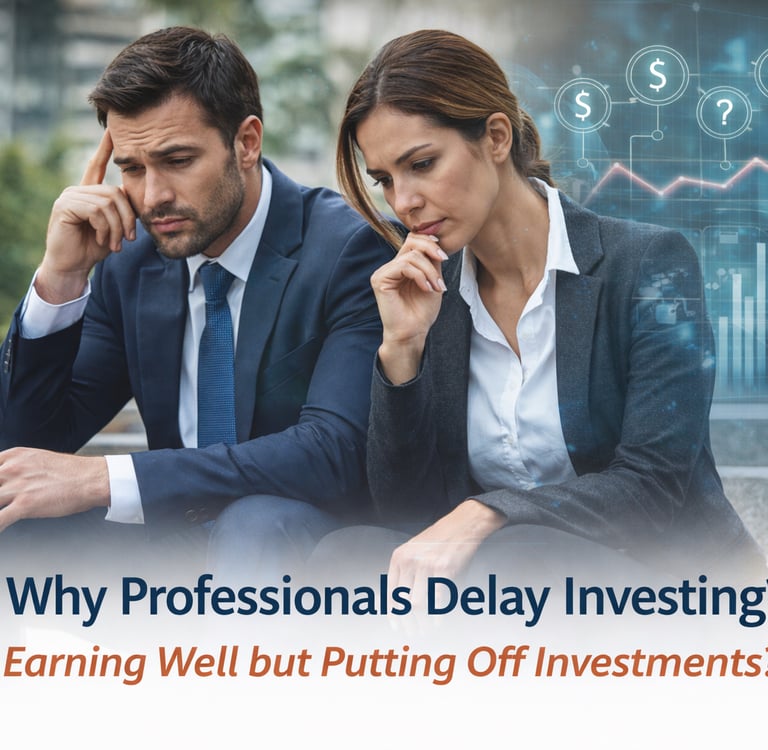
Most professionals understand the importance of investing. They read about it, hear about it, and even talk about it confidently with peers. Yet, when you look closely, a surprising number of highly educated, high-income professionals delay investing far longer than they should.
This delay is rarely due to lack of knowledge.
It is driven by subtle career psychology, misplaced confidence, and structural blind spots that quietly sabotage long-term wealth.
This article explores why professionals delay investing, how this behavior cuts across income levels and professions, and what needs to change before the cost becomes irreversible.
The Illusion of “I’ll Start When I’m Ready”
One of the most common long-tail search questions is:
Why am I not investing even though I earn well?
The honest answer is uncomfortable.
Professionals often believe there is a future version of themselves that will be:
More stable
More confident
Less busy
Better informed
So investing gets postponed until:
The next appraisal
The next job change
After buying a house
After settling family responsibilities
After “things calm down”
The problem is simple:
That future never arrives.
Careers grow more complex over time, not simpler. Waiting for clarity delays compounding—the one advantage salaried professionals cannot afford to lose.
High Income Creates a False Sense of Time
Many professionals delay investing because they earn well early.
This leads to dangerous assumptions:
“I can catch up later”
“My salary growth will compensate”
“I’ll invest seriously in my 40s”
This mindset is especially common among:
IT and corporate professionals
Doctors and specialists
Consultants and managers
Government and public sector employees
High income reduces urgency. But investing rewards time, not intelligence or income.
The result is a widening gap between earning well and building wealth.
Career Stability Is Mistaken for Financial Security
Another frequently searched concern is:
Why do salaried professionals delay investing?
Because many professionals confuse job stability with financial stability.
A stable job creates the comfort of predictability:
Regular salary
Benefits
Insurance
Retirement schemes
This comfort reduces the perceived need to invest independently.
But careers are effort-dependent.
Income stops when effort stops.
Investing is the only mechanism that allows money to work without daily effort—something most professionals realize only after mid-career pressure sets in.
Overthinking Becomes a Form of Inaction
Professionals are trained to analyze, compare, and optimize.
Ironically, this becomes a weakness in investing.
Common thought patterns:
“I need to understand everything first”
“Markets look risky right now”
“I’ll start once conditions improve”
“I don’t want to make a mistake”
This leads to endless reading, podcast listening, and discussion—without action.
In finance, delayed decisions are decisions.
They silently choose non-participation.
And non-participation has a cost.
Lifestyle Setup Comes Before Wealth Setup
Another long-tail query professionals search for is:
Why do professionals save but not invest?
Because savings feel safe. Investing feels uncertain.
Professionals often prioritize:
Lifestyle upgrades
Home ownership
Education expenses
Social expectations
Investing is postponed until “essential life costs” are handled.
But life costs never stop.
Without investing early, professionals lock themselves into:
Higher monthly commitments
Lower flexibility
Reduced risk tolerance
By the time investing feels urgent, freedom has already narrowed.
Fear of Volatility Hits Professionals Harder
Professionals are not afraid of work—but they are afraid of uncertainty.
Many ask:
Why do working professionals avoid investing in equity?
Because careers already feel risky:
Appraisals
Role changes
Performance pressure
Organizational politics
Investing adds another layer of perceived risk.
So professionals choose:
Fixed deposits
Low-return instruments
Over-conservative allocation
Ironically, this increases long-term risk by failing to beat inflation.
Employer Benefits Create Complacency
EPF, pension schemes, gratuity, and insurance create an illusion of completeness.
Professionals assume:
“This should be enough”
“The system is taking care of retirement”
But these benefits are designed for basic security, not financial independence.
Relying solely on employer structures delays:
Personal investing discipline
Asset diversification
Wealth ownership mindset
This is a structural reason many professionals invest too late.
Investing Is Emotionally Harder Than Working Hard
Hard work has immediate feedback:
Praise
Promotions
Salary hikes
Investing offers delayed gratification.
There are no instant rewards, no visible milestones early on, and frequent periods of doubt.
Professionals, conditioned for performance-based validation, struggle with this delay.
So they postpone investing until:
Confidence increases
Income feels “sufficient”
Fear reduces
Unfortunately, confidence grows after investing, not before.
The Hidden Cost of Delaying Investing
Delaying investing doesn’t just reduce returns.
It causes:
Lower compounding years
Higher pressure to invest aggressively later
Reduced margin for error
Increased emotional stress
Professionals who delay often enter markets later with:
Larger amounts
Higher expectations
Lower risk tolerance
This combination leads to poor timing and disappointment.
Why This Pattern Repeats Across Professions
This delay is not profession-specific. It appears among:
IT and corporate employees
Doctors and healthcare professionals
Lawyers and consultants
Government and public sector employees
Academicians and educators
The common factor is effort-based income.
When income depends on personal output, investing feels optional—until it becomes urgent.
This deeper connection between careers, psychology, and money is explained in detail in Finance for Working Professionals, which maps why earning well does not automatically translate into wealth.
How Professionals Can Break the Delay Cycle
Start before you feel ready
Separate investing from market opinions
Automate early, adjust later
Treat investing as career infrastructure
Focus on consistency, not optimization
Investing is not about timing the market. It is about refusing to delay participation.
Final Thought
Professionals do not delay investing because they are careless.
They delay because:
Careers reward effort immediately
Investing rewards patience invisibly
Stability creates complacency
Analysis replaces action
The real risk is not market volatility.
The real risk is postponing the only tool that converts professional effort into lasting financial independence.
If you want your career to support your future—not just your present—investing cannot remain a “later” decision.
Connect
Questions? Reach out anytime, we're here.
lifeworkwealth@gmail.com
© 2026 Life Work Wealth.
All rights reserved.All content published on this website is for informational and educational purposes only. No part of this website may be reproduced, distributed, or transmitted in any form or by any means without prior written permission, except where permitted by law.